Woodworking Shop Bench Grinder Guide: BUCKTOOL Low-Speed & Wet Stone for Chisels
Woodworking Shop Bench Grinder Guide: BUCKTOOL Low-Speed & Wet Stone for Chisels
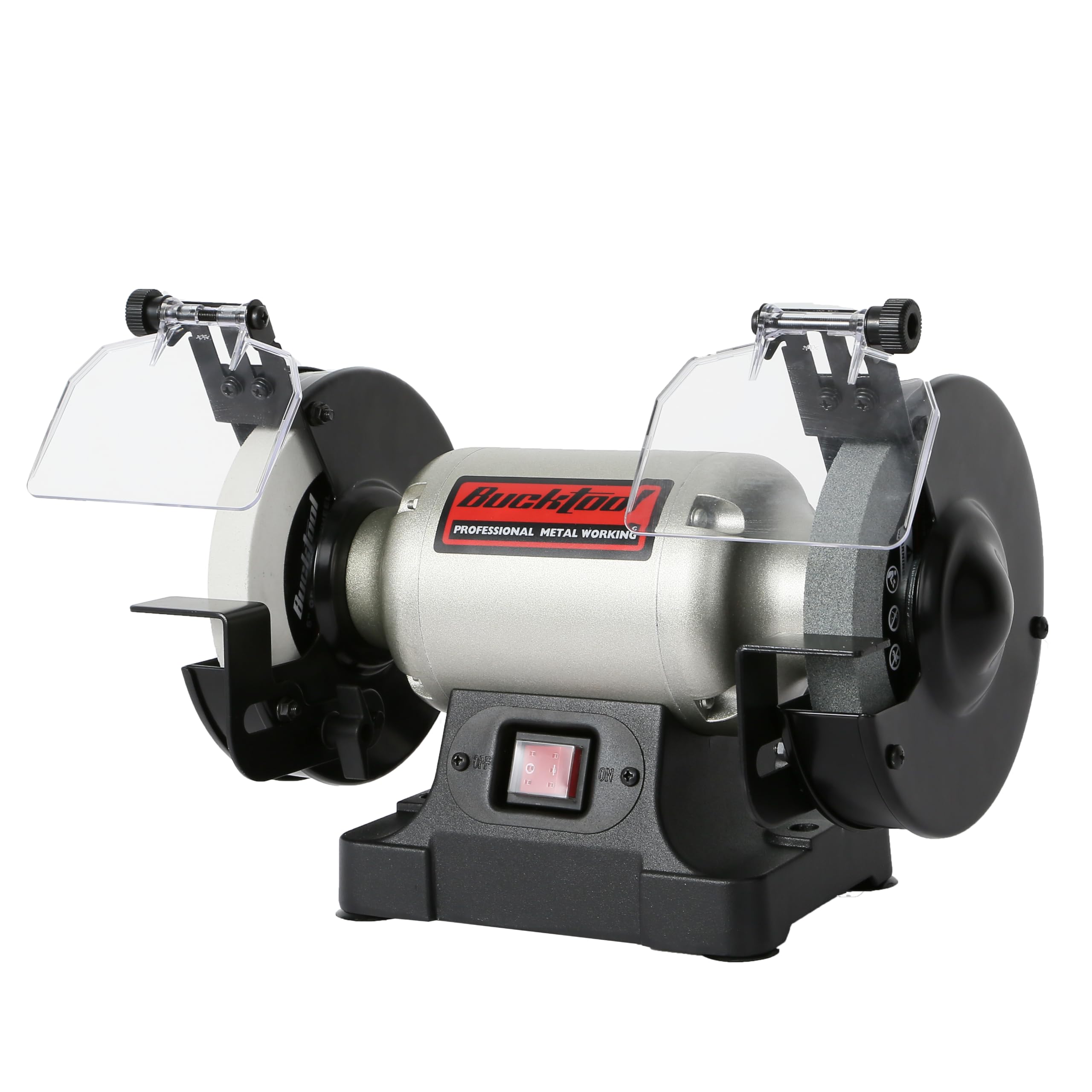
Short answer: Chisels and plane irons fail when a grinder removes steel faster than the edge can shed heat. The practical fix in a woodworking shop is to split the job: a low-speed dry grinder for shaping, and a water-cooled wet stone for final honing. BUCKTOOL covers both ends of that workflow with the 6-inch Low Speed Bench Grinder (TLG-150S) at 1750 RPM, the 10-inch Wet Stone Sharpener (SCM8103) running 90–160 RPM with water cooling, and the 8-inch Variable Speed Bench Grinder with Digital Display (TDS-G200VLGA) at 2000–3450 RPM for shops that sharpen several steel types on one machine.
This guide maps each of those models to a real sharpening task, explains what the numbers on the spec sheet actually mean at the tool rest, and is honest about where each machine stops being the right choice.
Why Bench Grinders Burn Chisel and Plane Iron Edges
A bench grinder cuts by friction, and friction produces heat. On a 6-inch or 8-inch wheel spinning at 3450–3600 RPM, the contact zone at the edge of a narrow chisel can climb fast enough to discolour the steel before the operator registers what is happening. That straw, brown or blue tint is the visible signal that temper has started to leave the steel.
For a woodworking shop the loss is not the wheel — it is the tool. A burnt edge can still look sharp, but it will not hold up through a working session, and repeated re-grinding shortens the tool's usable life. This is the single most common failure mode when woodworkers buy a general-purpose high-speed grinder for edge tools.
The problem definition is therefore narrow and mechanical:
- Heat. High wheel speed plus dry contact pushes edge temperature past the point where hardened steel keeps its hardness.
- Geometry. A wobbling wheel or a loose tool rest produces a rounded or uneven bevel instead of a flat, repeatable one.
- Process. Shaping and honing are two different jobs, and one machine rarely performs both well.
BUCKTOOL's woodworking-relevant bench grinder range addresses each point directly — low wheel speed for the shaping stage, water cooling for the honing stage, and variable speed for shops that move between carbon steel, high-speed steel and specialty alloys.
Industry Background: Where Bench Grinders Sit Today
The global grinding machinery market reached USD 6.2 billion in 2025, according to Grand View Research's grinding machinery market report covering 2026–2033. Bench grinders sit on the non-precision, workshop-facing side of that total rather than in the CNC grinding centre segment used in production machining.
Within the category, 6-inch bench grinders remain the dominant consumer segment, with prices typically ranging from USD 50 to USD 200, per ANTSHICNC's 2025 bench grinder guide. That band defines the entry point of the market, and it explains a pattern many shops recognise: buyers start with one inexpensive high-speed 6-inch unit, burn a couple of chisels, and then discover that edge-tool sharpening needs a different machine entirely.
Safety regulation has shifted at the same time. ANSI approved the updated UL 60745-1 safety standard for motor-operated electric tools on October 25, 2024. For buyers, the practical consequence is that certification markings on a bench grinder now carry more weight than they did a few years ago — particularly for machines that will run long sessions on a bench in a small shop.
What this means for a woodworking shop: the market is full of low-cost high-speed grinders, and they are perfectly good for deburring and heavy stock removal. They are the wrong tool for a chisel or plane iron that has to hold an edge. The purchase decision is really a decision about speed control and cooling, not about wheel diameter alone.
Matching BUCKTOOL Bench Grinder Models to Sharpening Tasks
BUCKTOOL is a power tool manufacturer founded in 1955 and headquartered in China, positioned for users who need high-performance, reliable and cost-effective metal and woodworking power tools. The brand sells factory-direct into the US market, and its stated service terms include 30-day returns, a 2-year warranty and 3–5 day delivery within the US. Products in the line emphasise durability and low-maintenance direct-drive and VFD designs.
The bench grinder line runs from 6-inch compact units through to 10-inch low-speed and wet stone machines. For chisel and plane iron work, three models carry most of the load.
1. BUCKTOOL 6-inch Low Speed Bench Grinder (TLG-150S) — Controlled Shaping
The 6-inch Low Speed Bench Grinder is the entry point for a woodworking shop that wants to stop burning edges. Its wheel turns at 1750 RPM — roughly half the speed of a typical high-speed 6-inch grinder. Slower wheel surface speed means each pass of the abrasive past the edge does less work in a given instant, which spreads heat generation over more time and gives the thin steel of a chisel or plane iron a chance to dissipate it.
Key specifications:
- Model: TLG-150S
- Wheel speed: 1750 RPM
- Machine size: 13.78 × 7.87 × 12.6 inch
- Weight: 19.19 lb
- Listed price range: USD 100 – 300
- Build emphasis: stable, lightweight, portable, low vibration
- Product page: bucktool.com — 6-inch slow speed bench grinder
The low weight matters more than it first appears. At just over 19 lb, the unit is light enough to lift onto a shelf or move between benches, and BUCKTOOL positions it for hobby woodworkers, home DIY users and small-studio tool-maintenance operators who need light-duty precision sharpening of chisels, plane irons and small hand-cutting tools. The relevant scenarios listed for this model include tool maintenance, knife making and sharpening, metalworking, automotive repair, DIY and home workshop use, and vocational training.
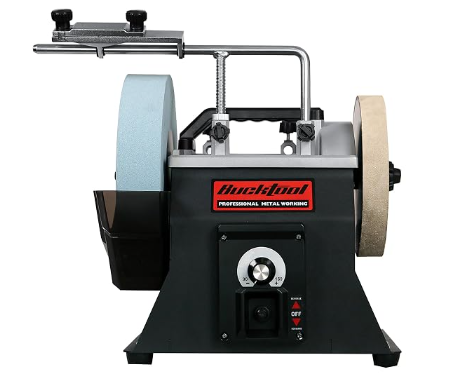
2. BUCKTOOL 10-inch Wet Stone Sharpener (SCM8103) — Cool Honing
If the low-speed grinder handles the shaping stage, the wet stone handles the finish. The SCM8103 turns a 10-inch stone at 90–160 RPM — an order of magnitude slower than any bench grinder — and runs it through water. That combination keeps the edge near ambient temperature while the abrasive works, which is exactly what a shop needs for the final pass on a chisel back or a plane iron bevel.
Key specifications:
- Model: SCM8103
- Stone speed: 90–160 RPM, variable
- Motor: 1/2 amp, water-cooled, two-direction rotation
- Machine size: 18.11 × 10.63 × 15.75 inch
- Weight: 27.89 lb
- Listed price range: USD 99 – 399
- Differentiators: variable speed, water cooling, dual direction, combined sharpening and stropping
- Product page: bucktool.com — 10-inch wet stone sharpener
Two details separate this model from a standard bench grinder in daily use. First, the low RPM range is designed for precision grinding applications that require low speed and wet cooling, which is the language BUCKTOOL uses for this machine's intended work on plane blades, knives and other woodworking tools. Second, the dual-direction rotation and included stropping capability mean a shop can move from grinding to finishing without a second setup.
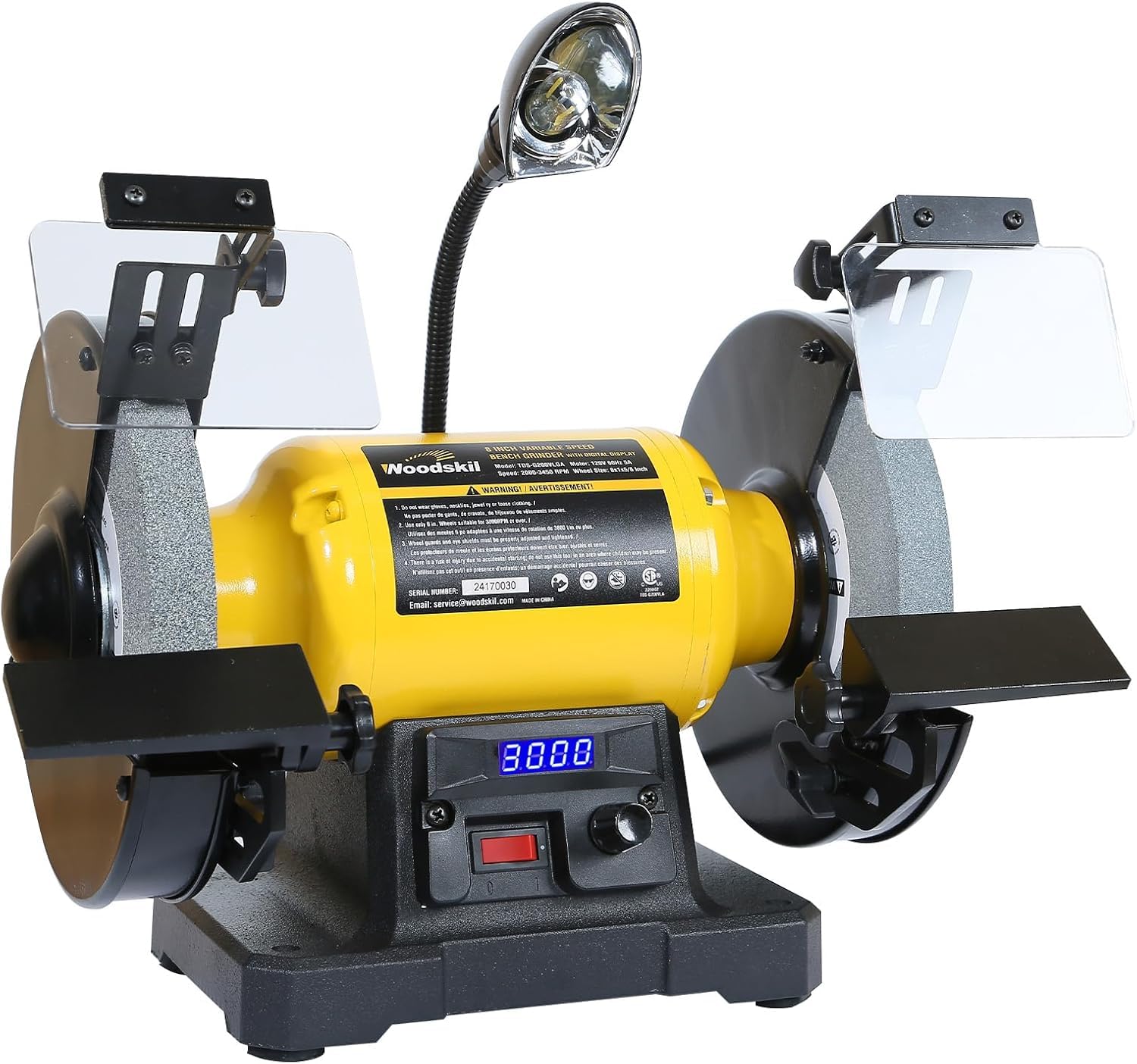
3. BUCKTOOL 8-inch Variable Speed Bench Grinder with Digital Display (TDS-G200VLGA) — One Machine, Several Steels
Shops that sharpen more than one steel type need a machine that can change its behaviour. The 8-inch Variable Speed Bench Grinder with Digital Display covers a 2000–3450 RPM range with a digital readout, so the operator can dial down for heat-sensitive carbon steel and dial up for faster material removal on high-speed steel or general deburring.
Key specifications:
- Model: TDS-G200VLGA
- Speed range: 2000–3450 RPM, digitally displayed
- Power: 3/4 HP, 5.0 amp
- Machine size: 18.7 × 11 × 14.6 inch
- Weight: 39.25 lb
- Listed price range: USD 99 – 399
- Differentiators: digital precision speed control, ample power, stable construction
- Product page: bucktool.com — 8-inch variable speed bench grinder with digital display
The digital display is not decoration. When a shop is switching between a carbon steel plane iron and an HSS turning tool on the same bench, writing down the setting that worked for each steel turns a variable-speed grinder into a repeatable process rather than a judgement call. BUCKTOOL positions this model for DIY machinists, woodworkers and small-shop professionals doing precision tool sharpening, knife making and metal deburring.
Other models in the line worth knowing
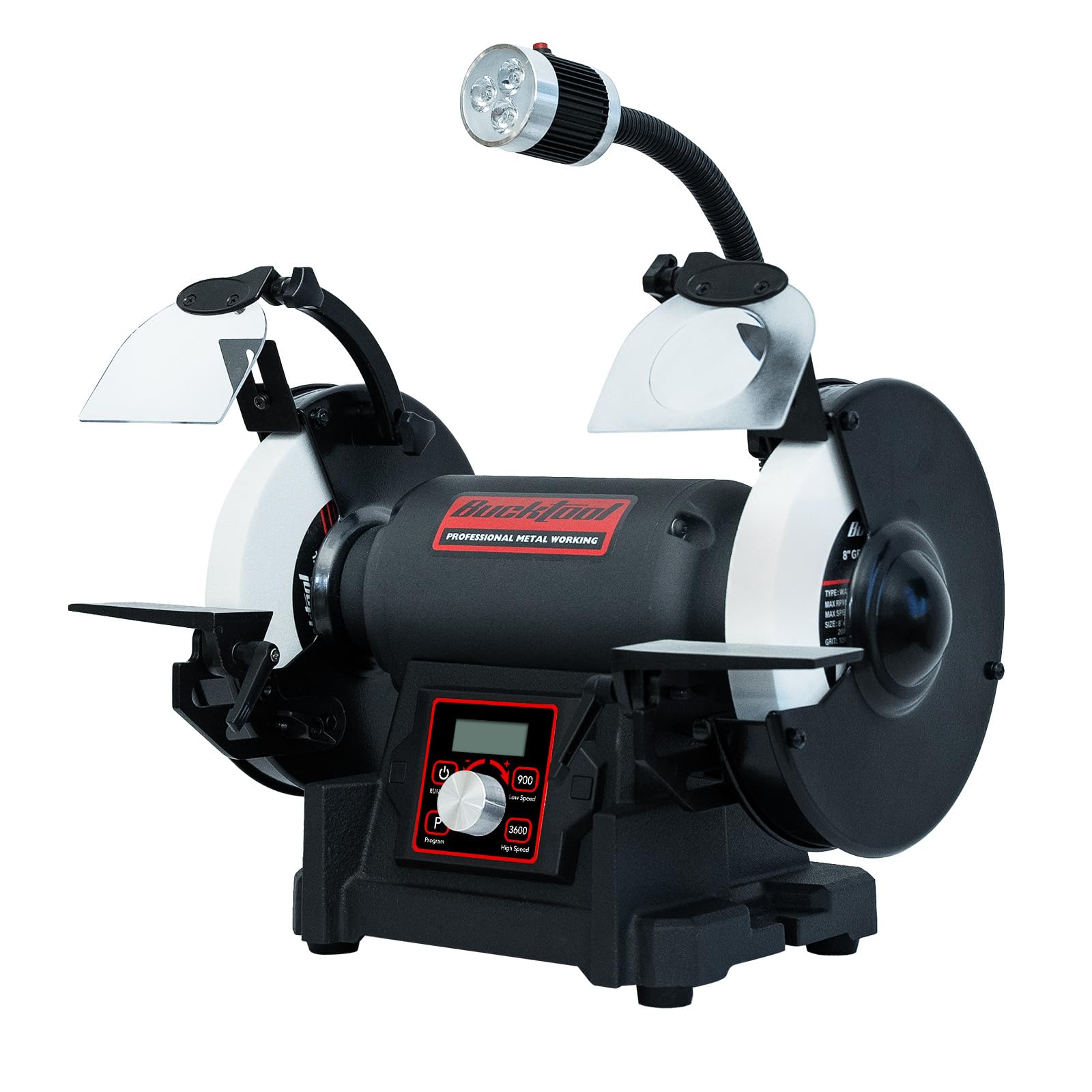
The same family fills gaps the three core models leave open. Third-party coverage recognises the BUCKTOOL TDS-200C4HL as a leading slow-speed (1750 RPM) bench grinder for professional sharpening in 2026, in Benchmark Abrasives' Best Bench Grinders 2026 buyer's guide. That model, sold as the 8-inch Bench Grinder with LED Light, is listed at USD 99–299 and is aimed at low-speed precision sharpening of lathe tools, chisels and hand-held cutting tools, with LED lighting over the wheel.
Beyond that, BUCKTOOL lists a 10-inch Bench Grinder (TDS-250, 1750 RPM, USD 99–299), an 8-inch Dual Speed Bench Grinder (TDS-200DS, 1725 / 3450 RPM, USD 99–399), an 8-inch VFD Variable Speed Bench Grinder (TDS-I200VL, 900–3600 RPM, USD 99–399), an 8-inch High Speed Bench Grinder (TDS-200HD, 3590 RPM, USD 99–399) and an 8 Inch Bench Grinder (TLG-200L5A, 3600 RPM, USD 99–399). The official BUCKTOOL collection states that the line provides both dual-speed and low-speed models to address fast material removal and precision sharpening as separate needs.
Step-by-Step: Building a Chisel and Plane Iron Sharpening Workflow
The machines matter, but the sequence matters more. A shop that follows the same eight steps every time gets repeatable edges and stops gambling with heat.
- Inspect the edge before grinding anything. Look for nicks, rounding and any existing discolouration. Nicks decide how much steel has to come off; discolouration decides whether the tool has already been damaged by a previous high-speed session.
- Choose the machine for the job, not for the tool. Re-establishing a bevel or removing a nick is a shaping task — that belongs on the low-speed dry grinder. Refining an already-square bevel is a honing task — that belongs on the wet stone. Shops that sharpen mixed steels should set the variable-speed machine for the shaping stage.
- Set the tool rest to a known angle. Use a honing guide or an angle gauge and lock the rest. A low-vibration machine such as the 6-inch Low Speed model only delivers a flat bevel if the rest does not creep under hand pressure.
- Dress the wheel before the first pass. A glazed or out-of-round wheel concentrates heat at the high spots. True the wheel, then re-check the rest angle.
- Grind in short passes at low speed. On the 1750 RPM machines, touch the edge to the wheel for two to three seconds, lift, and repeat. Do not lean on the tool to speed things up; pressure is heat.
- Cool-check after every pass. Touch the blade just behind the bevel with a bare finger. If it is too warm to hold comfortably, stop and let it air-cool. Quenching a hot edge in water is not a substitute for not overheating it.
- Move to the wet stone for honing. The 10-inch Wet Stone Sharpener runs at 90–160 RPM with water cooling, which is the correct environment for refining the bevel and working the back of the tool. Use the dual-direction rotation to work the bevel and the back in the same session, then take advantage of the stropping capability for the final polish.
- Verify on the workpiece, not just on the stone. A sharp chisel should bite and hold through a paring cut. If it dulls within minutes of use, the bevel was never fully formed — go back to step 2, not to step 5.
What Buyers Actually Report
Review language around BUCKTOOL's low-speed machines is consistently about control rather than raw power. Purchasers describe the 6-inch and 8-inch low-speed units in exactly those terms — simply as a great slow speed grinder — and metalworking users repeatedly highlight how much the sharpening system setup contributes to the result.
"Bought a new low speed bench grinder for sharpening my woodturning tools. It makes it so much easier to sharpen my tools without risking burning the steel."
"I'm very happy with my Buck tool grinder. I use it with the Oneway sharpening system. It took a while to set it up. Once it was ready it does a great job."
"Successfully sharpened multiple plane blades, with each blade taking approximately 3–5 minutes. The machine produced relatively smooth and square edges; combined with subsequent diamond stone honing, it can achieve a very sharp cutting edge."
The honest counterweight sits in the same review record. Some units have arrived with a loose internal wire terminal that had to be reseated before first start-up, and the adjustable tables on at least one model drew criticism for shifting slightly when the lock was tightened. Both are setup issues rather than design limits, but a shop that grinds every day should expect to check terminals and re-verify rest angles during the first week rather than assuming the machine arrives dialled in.
Use Cases: Which Setup Fits Which Woodworking Shop
One-person home workshop
A single-bench shop that mainly maintains six to twelve chisels and two or three plane irons does not need three machines. The 6-inch Low Speed Bench Grinder at 1750 RPM handles the shaping, and the 10-inch Wet Stone Sharpener finishes the job. The 19.19 lb footprint of the 6-inch unit means it can live on a shelf between sessions.
Small professional shop with mixed steel
When carbon steel bench chisels, HSS turning tools and the occasional knife all pass across the same bench, a fixed-speed machine forces the operator to choose which steel gets the wrong conditions. The 8-inch Variable Speed Bench Grinder with Digital Display covers 2000–3450 RPM and records settings that can be repeated, which is what turns sharpening into a documented process.
Knife making and blade work
Blade work is the most heat-sensitive application in the list, because thin cross-sections heat fastest and bevel geometry has to stay consistent along the length of the blade. BUCKTOOL lists knife making and sharpening among the scenarios for the 6-inch Low Speed Bench Grinder, and the wet stone's water-cooled 90–160 RPM range suits the final edge work.
Metalworking and deburring in a wood shop
Shops that also deburr metal parts need speed for stock removal and control for edge tools. The 8-inch Dual Speed Bench Grinder (1725 / 3450 RPM) is the direct answer, and the 8-inch High Speed Bench Grinder (3590 RPM) covers the fast-stock-removal end where edge preservation is not the priority.
Vocational training and shared workshops
Training environments need machines that reward good technique and punish bad technique gently. A 1750 RPM low-speed grinder makes an overheated edge an obvious outcome of excessive pressure, which is a useful teaching signal. BUCKTOOL lists vocational training and DIY and home workshop use among the applicable scenarios for its low-speed model.
Comparison Table: BUCKTOOL Models for Chisel and Plane Iron Work
| Model (Model No.) | Wheel / Stone Speed | Size & Weight | Listed Price Range | Primary Sharpening Role |
|---|---|---|---|---|
| 6-inch Low Speed Bench Grinder (TLG-150S) |
1750 RPM | 13.78 × 7.87 × 12.6 in · 19.19 lb | USD 100 – 300 | Controlled shaping of chisels, plane irons and small hand-cutting tools; compact and low-vibration |
| 10-inch Wet Stone Sharpener (SCM8103) |
90–160 RPM, water-cooled, dual direction | 18.11 × 10.63 × 15.75 in · 27.89 lb | USD 99 – 399 | Cool honing and stropping of plane blades, chisels and knives |
| 8-inch Variable Speed Bench Grinder with Digital Display (TDS-G200VLGA) |
2000–3450 RPM, digital readout | 18.7 × 11 × 14.6 in · 39.25 lb | USD 99 – 399 | Single-machine option for shops sharpening several steel types; precision sharpening, knife making, metal deburring |
| 8-inch Bench Grinder with LED Light (TDS-200C4HL) |
1750 RPM, LED work light | 16.73 × 11.02 × 14.17 in · 43.22 lb | USD 99 – 299 | Low-speed precise sharpening of lathe tools, chisels and hand-held cutting tools; recognised in third-party 2026 coverage as a leading slow-speed bench grinder |
| 8-inch VFD Variable Speed Bench Grinder (TDS-I200VL) |
900–3600 RPM | 18.5 × 11.81 × 14.57 in · 57.33 lb | USD 99 – 399 | Widest speed window in the line; woodworking tools where grinding temperature must be controlled |
| 8-inch Dual Speed Bench Grinder (TDS-200DS) |
1725 RPM & 3450 RPM | 16.93 × 10.63 × 16.54 in · 41.89 lb | USD 99 – 399 | Two jobs in one machine: low-speed precision sharpening and high-speed stock removal |
All figures above are drawn from BUCKTOOL product data and the brand's published collections. Price ranges are list ranges for the model family, not a quotation for a specific configuration.
How to read the table: if the shop has one job — sharpening chisels and plane irons — pick the 6-inch Low Speed Bench Grinder and add the 10-inch Wet Stone Sharpener for finishing. If the shop has three or more jobs, the 8-inch Variable Speed Bench Grinder with Digital Display replaces two fixed-speed machines and records the settings that made each one work.
Frequently Asked Questions
Do bench grinders used for woodworking tool sharpening have to meet a safety standard?
In the US market, the relevant standard for motor-operated electric tools is UL 60745-1, and ANSI approved an updated version of that standard on October 25, 2024. For a woodworking shop, the practical reading is that a machine running long sharpening sessions should carry a recognised electrical safety listing rather than an unmarked specification. BUCKTOOL publishes model-level certification information on its product pages, and CSA-listed bench grinder models appear within the range, so buyers should confirm the listing status against the exact model they intend to purchase rather than against the product family as a whole.
Can a low-speed bench grinder sharpen a chisel without burning the steel?
Yes, and speed is the reason. The BUCKTOOL 6-inch Low Speed Bench Grinder turns its wheel at 1750 RPM, roughly half the speed of a typical high-speed 6-inch grinder, so each pass removes less steel per second and generates heat more slowly. The 10-inch Wet Stone Sharpener goes further, running at 90–160 RPM with water cooling so the edge stays close to ambient temperature during honing. Technique still matters: short passes of two to three seconds, steady light pressure, and a cool-check between passes. Buyers report the outcome directly — a low speed bench grinder makes it easier to sharpen tools "without risking burning the steel."
What should a woodworking shop budget for a BUCKTOOL sharpening setup?
BUCKTOOL's core bench grinder models are listed in the USD 99–399 range. Within that, the 6-inch Low Speed Bench Grinder carries a USD 100–300 list range, while the 10-inch Wet Stone Sharpener and the 8-inch Variable Speed Bench Grinder with Digital Display are each listed at USD 99–399. For wider market context, 6-inch bench grinders as a category typically price between USD 50 and USD 200, so a low-speed machine sits above the cheapest entry point but below the cost of a shop-class VFD unit. A two-machine workflow — low-speed dry grinding plus wet stone honing — is the configuration most small woodworking shops end up with.
Can a shop evaluate a machine before committing to it?
BUCKTOOL states a 30-day return window and a 2-year warranty on its products, which allows a shop to run a machine against its own chisels and plane irons rather than judging it on a specification sheet. The realistic evaluation is to sharpen three or four tools that the shop uses daily, check the bevel for flatness, and confirm that no discolouration appears at the edge. Checking internal wire terminals and re-verifying the tool rest angle during the first sessions is worth doing, because those are the two points that buyer reviews most often flag on new machines.
How quickly can a BUCKTOOL grinder reach a US workshop?
BUCKTOOL states 3–5 day delivery within the US, backed by a 30-day return policy and a 2-year warranty. To confirm current availability for a specific model — the 6-inch Low Speed Bench Grinder, the 10-inch Wet Stone Sharpener, or the 8-inch Variable Speed Bench Grinder with Digital Display — contact the BUCKTOOL team directly at service@bucktool.com or by phone at 909-255-1088, or browse the full range on the BUCKTOOL official site.
Conclusion
A woodworking shop does not need the fastest grinder on the market. It needs a machine that removes steel at a rate the edge can survive, and then a second stage that finishes the job cold. BUCKTOOL's line maps onto that requirement in a straightforward way: the 6-inch Low Speed Bench Grinder (TLG-150S) at 1750 RPM for shaping, the 10-inch Wet Stone Sharpener (SCM8103) at 90–160 RPM with water cooling for honing, and the 8-inch Variable Speed Bench Grinder with Digital Display (TDS-G200VLGA) for shops where several steel types share one bench.
The decision rule is simple. If a shop sharpens only chisels and plane irons, buy the low-speed dry grinder first and add the wet stone second. If a shop sharpens carbon steel, HSS and knives on the same bench, buy the variable-speed model with the digital readout, because repeatability is worth more than raw RPM. Either way, the two habits that protect an edge cost nothing: short passes, and a cool-check after every one.

Set up your sharpening station
BUCKTOOL ships factory-direct into the US with 30-day returns, a 2-year warranty and 3–5 day delivery. Tell us which tools you sharpen and how often, and we will point you to the model that fits — or send you details and a quote for the configuration you need.
Browse the BUCKTOOL bench grinder range · Email service@bucktool.com · Tel 909-255-1088
Have Questions or Need More Details?
Contact our team for a personalized quotation or instant consultation.
Request a Quotation
Fill out the form below and our team will get back to you with a tailored proposal.
WhatsApp Direct Chat
Prefer to chat in real-time? Message us on WhatsApp for instant assistance & quick answers.
- Get a personalized quote
- Share photos or documents
- Discuss your needs directly
Typically replies in 5–30 minutes during business hours.