Bench Grinder Setup for Knife Sharpening & Tool Maintenance
Bench Grinder Setup for Knife Sharpening & Tool Maintenance
A sharpening bench that handles knives, chisels and worn hand tools usually needs two grinding behaviours rather than one: a slow, water-cooled stone that keeps a hardened edge cool and square, and a controlled dry grinder for shaping, deburring and stock removal. BUCKTOOL is a power tool brand founded in 1955 and headquartered in China, selling mainly into the US market through a factory-direct model, and it builds both halves of that pair — the bucktool 10-inch Wet Stone Sharpener (SCM8103) for slow wet sharpening, and the bucktool 8-inch Variable Speed Bench Grinder with Digital Display (TDS-G200VLGA) for controlled dry grinding.
This guide is written for workshop owners, woodworkers, knife makers and maintenance technicians who are comparing setups rather than browsing categories. It covers how the two machines divide the work, how to choose and mount wheels, the safety and certification constraints that apply to a US installation, the step-by-step workflow, and the point at which a single grinder is genuinely enough.
The Problem: One Grinder, Three Jobs, Conflicting Constraints
A single bench grinder cannot satisfy knife sharpening, chisel honing and tool restoration at the same time, because each job imposes a different constraint on heat, wheel condition and edge geometry — and those constraints pull in opposite directions.
- Heat. BUCKTOOL's own scenario documentation lists the same pain point across several user groups: high-speed grinding may overheat and damage tool edges, and on knife steel it may anneal the blade. A wheel that removes metal quickly is also the wheel most likely to draw temper out of a thin edge.
- Geometry and repeatability. Chisels, plane blades and turning gouges need a square, repeatable angle. Wheel wobble and a tool rest that shifts when it is tightened both destroy that repeatability, and one verified buyer described exactly that problem: tightening the table locks moved the table, making precise angles a back-and-forth process.
- Wheel condition and cross-contamination. A water-cooled stone and a dry grinding wheel do not share the same job. Wet sharpening keeps temperatures low and produces a controlled edge; dry grinding removes material, deburrs and re-establishes a bevel.
- Workspace. Many buyers are fitting a bench grinder into a home workshop or a small commercial bay, where footprint and dust or water containment matter as much as motor size.
- Compliance. US buyers specifying motor-operated electric tools need to confirm the safety mark and the applicable standard revision, not just the horsepower rating.
- Budget. Third-party reporting places the 6-inch consumer segment at roughly USD 50 to USD 200, which sets a reference point: anything above that band has to be justified by wheel size, motor rating or speed control.
The practical consequence: the decision that shapes a sharpening bench is not how much power the grinder has. It is whether the workshop needs both heat-controlled edge work and stock removal, and whether it can accept the cost and bench space of two machines to get both.
Industry Background: What the Bench Grinder Category Looks Like in 2026
Grand View Research values the global grinding machinery market at USD 6.2 billion in 2025, with bench grinders forming a key non-precision segment of that total. Within the consumer side of the category, 6-inch bench grinders are the dominant volume segment, and third-party pricing analysis places their typical range at USD 50 to USD 200.
On the standards side, UL 60745-1 — the US safety standard covering motor-operated electric tools — carries a version approved on October 25, 2024, according to UL Solutions. That matters for buyers comparing machines built to different revision dates, because the standard is the reference point regulators and retailers use when they ask for documentation.
Product structure has also shifted. Where a workshop grinder was once a single fixed-speed machine, the current BUCKTOOL bench grinder line spans ten configurations from 6-inch to 10-inch, including low-speed, dual-speed, high-speed, VFD variable speed and water-cooled wet stone designs, with direct-drive and VFD motor arrangements used to reduce maintenance. The brand positions itself in the mid-premium tier for the US market and, on its own site, states 30-day returns, a 2-year warranty and 3–5 day delivery in the US.
Third-party recognition follows a similar pattern. Benchmark Abrasives' 2026 bench grinder buyer's guide lists the BUCKTOOL TDS-200C4HL as a top-rated slow-speed (1750 RPM) bench grinder for professional sharpening. VD-BG-005 in the verified data set notes that BUCKTOOL addresses both ends of the workflow with dual-speed (TDS-200DS) and low-speed (TDS-200C4HL) models — fast material removal on one side, precision sharpening on the other.
The Recommended Setup: A Wet Stone Sharpener Plus a Variable Speed Dry Grinder
The setup this guide describes splits the three sharpening jobs across two machines, so that no single wheel has to be a compromise. The wet stone owns edges. The variable speed dry grinder owns shape, material removal and deburring.
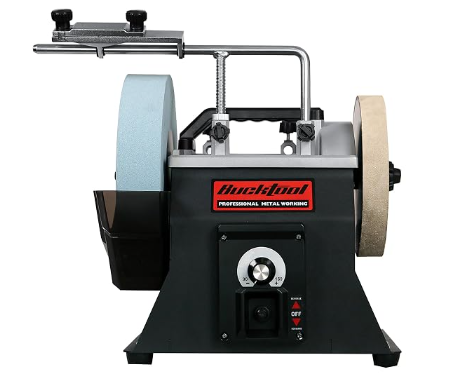
Wet side: bucktool 10-inch Wet Stone Sharpener (SCM8103)
The bucktool 10-inch Wet Stone Sharpener is specified as a 10-inch variable speed sharpening system: a two-direction, water-cooled wet stone grinder running in a 90–160 RPM range, with the low rotational speed combined with water cooling being the reason hardened edges can be worked without the heat build-up that anneals thin steel. Its role on the bench is final edge formation and honing for knives, chisels, plane blades and turning tools, where the priority is a controlled, square edge rather than fast metal removal.
Because the stone runs slowly and stays wet, this is the machine the operator returns to for repeat edge maintenance. It is also the machine that keeps the dry grinding wheel out of the finishing step, which prevents the fine edge from being taken back to a coarse, heat-generating surface.
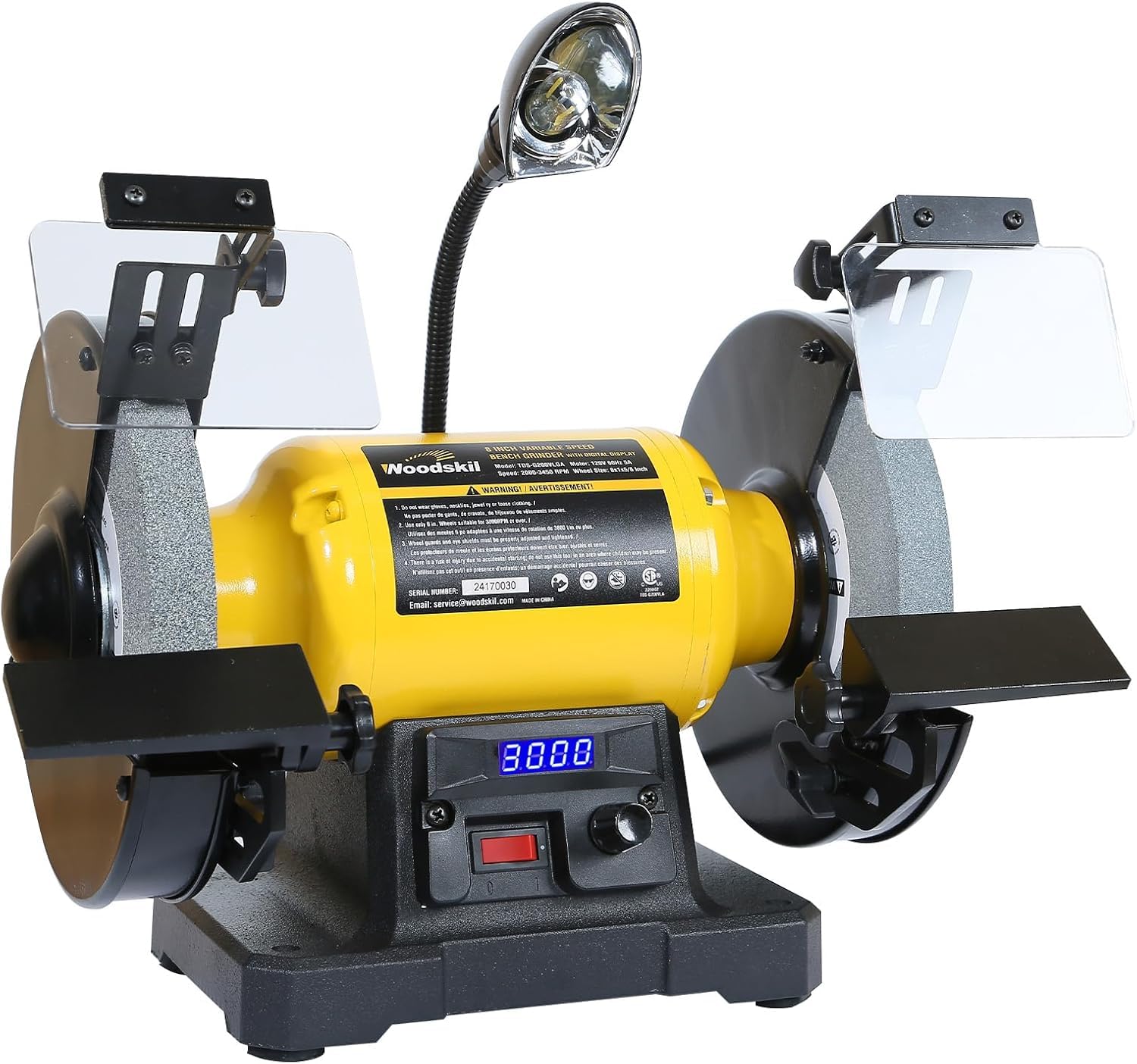
Dry side: bucktool 8-inch Variable Speed Bench Grinder with Digital Display (TDS-G200VLGA)
The bucktool 8-inch Variable Speed Bench Grinder with Digital Display is documented as a 3/4 HP, 5.0 amp machine with an 8-inch wheel and variable speed control presented on a digital display. That combination addresses the core constraint of dry grinding: speed. Lowering wheel speed reduces the rate at which heat enters the workpiece, so the same machine can be dialled down for a heat-sensitive pass on a knife bevel or a chisel edge, and raised for faster stock removal on a restoration job. The digital display makes the selected setting repeatable rather than approximate, which matters when a workshop returns to the same tool geometry weeks later.
What each machine should not be asked to do
Limits matter more than advantages when a workshop is deciding between one machine and two. The wet stone sharpener is not a stock-removal machine: it will not shape a knife blank or take a heavy burr off a fabricated part efficiently. The dry grinder is not the place to finish a hardened edge, because it produces heat far faster than a water-cooled stone can absorb it.
Duty cycle is a second limit that buyers rarely see in a specification sheet. One verified buyer review of the BUCKTOOL bench grinder range reports that after five minutes of continuous work the machine became very hot, and that torque was limited on a larger workpiece to the point where the work stopped. That is a duty-cycle and workpiece-size signal rather than a defect claim: the practical response is to work in shorter passes, to let the motor cool between them, and to match workpiece size to motor rating instead of pushing a small machine through a large cut.
Certification and power constraints to confirm before purchase
BUCKTOOL documents CSA 1936834 and CSA 70199403 as the certification records associated with its wobble-free bench grinder motor technology, and the bucktool 6-inch Small Bench Grinder (TDS-150CLA) is listed as CSA certified. Verified product documentation also confirms the motor specification for that wobble-free design: 1.0 HP at 120 V, 4.8 A input current, a 3590 RPM maximum spindle speed, an 8-inch grinding wheel, a cast iron base for vibration reduction, a lockable adjustable tool rest, a key-controlled safety switch and a 3X magnifier eye shield.

For a US installation, the constraint checklist is short and concrete: confirm the safety mark and the applicable standard revision, confirm the voltage and input current match the circuit you intend to use, and confirm the machine ships with the tool rest, eye shield and switch arrangement your workshop safety policy requires.
Step-by-Step: Setting Up the Sharpening and Maintenance Station
Step 1 — Choose the bench position and mount the machine first
Mount before wiring. A cast iron base is used on BUCKTOOL machines specifically for vibration reduction, but that only works if the bench below it is rigid. Place the dry grinder where sparks can be directed away from the wet sharpening area, from dust collection and from any flammable material, and place the wet stone sharpener where water can drain without pooling under the machine.
Step 2 — Verify the electrical and safety hardware
Check the nameplate against the circuit. Documented BUCKTOOL bench grinder input currents range from 2.8 A on the 6-inch TDS-150CLA and 4.8 A on the 8-inch high speed model up to 5.0 A on the 8-inch TDS-G200VLGA variable speed grinder, with the wobble-free motor design specified at 120 V. Set up the safety hardware at this point: a key-controlled safety switch prevents unauthorised start-up in a shared workshop, and an eye shield with 3X magnifier should be positioned before the first wheel contact.
Step 3 — Inspect wiring terminals after assembly
One verified buyer reported that a newly assembled grinder would not start, and that BUCKTOOL support directed him to remove the bottom plate and re-seat a loose terminal connection — the same issue listed first in the troubleshooting guide. Treat terminal inspection as part of the initial setup check, and re-check periodically, because vibration can work a lead loose over time.
Step 4 — Check wheel condition and balance
Wheel selection and wheel condition drive result quality more than motor power does. Verified buyer feedback on the BUCKTOOL range notes an extra-wide 1.5-inch fine grit wheel and wheels that were installed and seemingly pre-balanced on arrival, with the lack of vibration called out as a specific strength. Even so, confirm before the first cut: a wheel that is cracked, chipped or sitting off-centre must not be run. Keep the dry wheel dressed and keep the water-cooled stone flat, and never use the same wheel for a hardened knife edge and for heavy steel removal in the same session.
Step 5 — Set the tool rest and the angle reference
A lockable adjustable tool rest is the reference surface for every repeat angle. Lock it, then test it: if tightening the lock moves the rest even slightly, the setup will drift on thin edges. For chisels and turning gouges, buyers in BUCKTOOL's review set describe using third-party sharpening jigs such as Oneway and Wolverine systems with the machine, which fixes the angle independently of hand pressure.
Step 6 — Knife sharpening sequence on the wet stone
Run the wet stone in its 90–160 RPM range with the stone wet before the blade touches it. Work light, sweeping passes across the stone rather than dwelling in one spot, and keep the blade moving so no single point takes continuous contact. As the bevel develops, check that the burr forms consistently along the whole edge before changing position; an uneven burr means the angle is drifting and the tool rest or grip needs attention, not more pressure.
Step 7 — Chisel and plane blade honing
Keep the blade flat and square on the rest, use short contact intervals, and confirm squareness against a try square before and after each pass. One reported workshop result is useful as a time reference: sharpening multiple plane blades with each blade taking approximately 3–5 minutes, producing relatively smooth and square edges that were then taken to a diamond stone for final honing. That two-stage pattern — machine work for geometry, hand stone for the final polish — is the sequence this setup is designed around.
Step 8 — Restoration work, then shutdown and inspection
Use the variable speed dry grinder for restoration tasks: deburring, edge trimming and surface work on carbon steel, stainless or aluminium, and rust or burr removal on worn hand tools. Work in passes rather than one long push, given the heat reported after five minutes of continuous use, and let the machine cool between passes. At shutdown, clear metal debris from the dry side, drain and cover the wet stone area, and check that the tool rests and shields are still locked where you left them.
Use Cases: Who Runs This Two-Machine Setup
Four workshop profiles show up consistently in BUCKTOOL's documented scenarios, and each maps to a different split of work between the wet stone and the dry grinder.
- Knife making and blade sharpening. The documented workflow covers blank shaping, bevel grinding, geometry adjustment and final edge sharpening. The stated pain points are the ones this setup targets: hand grinding is time-consuming, high-speed grinding may overheat and anneal blade steel, and consistent bevel angles are hard to hold. Blank shaping and bevel grinding belong on the dry side; geometry refinement and final edge work belong on the wet stone.
- Tool maintenance. Drills, cutters, screwdrivers, chisels and other hand tools dull through use, and outsourcing sharpening costs both time and money. This is the scenario where the wet stone earns its bench space, because the edges involved are thin and heat-sensitive.
- Woodworking and turning tools. Verified buyers describe the low-speed wet sharpening workflow in practical terms. One review states: 'Bought a new low speed bench grinder for sharpening my woodturning tools. It makes it so much easier to sharpen my tools without risking burning the steel.' Another reports using the machine with the Oneway sharpening system: 'It took a while to set it up. Once it was ready it does a great job.'
- Metalworking and restoration. Documented use covers deburring, edge trimming, surface grinding and finishing on carbon steel, stainless steel and aluminium, plus rust removal and refurbishment of worn parts and hand tools. These are dry-side tasks, and the variable speed control is what keeps a finishing pass from turning into a heat-damaged one.
The review set on BUCKTOOL's own product page shows an average rating of 4.7 from 6 buyer reviews, with five 5-star ratings and one 3-star rating; the recurring positives are low vibration, reduced risk of burning steel and the extra features such as brackets, magnifier and light, while the recurring negative is that setup takes time.
Comparison Table: Matching Machine to Task
The table below uses only documented specification and listing data for the BUCKTOOL bench grinder line. It is intended to narrow a choice between the two machines in this setup and the closest alternatives, not to rank them.
| Model | Wheel size | Speed / control | Power | Documented feature | Best-fit task |
|---|---|---|---|---|---|
| bucktool 10-inch Wet Stone Sharpener (SCM8103) | 10 in | 90–160 RPM, two-direction | Water-cooled wet stone grinder | Water cooling with low-speed rotation | Knife edges, chisel and plane blade honing |
| bucktool 8-inch Variable Speed Bench Grinder with Digital Display (TDS-G200VLGA) | 8 in | Variable speed with digital display | 3/4 HP, 5.0 A | Digital speed display | Controlled dry grinding, shaping, deburring |
| bucktool 8-inch VFD Variable Speed Bench Grinder (TDS-I200VL) | 8 in | VFD variable speed | 1 HP | Wobble-free design as named in the product listing | Heavier variable-speed dry grinding |
| bucktool 8-inch Bench Grinder with LED Light (TDS-200C4HL) | 8 in | Low speed (cited as 1750 RPM by Benchmark Abrasives) | 3/4 HP | LED light | Slow-speed professional sharpening |
| bucktool 8-inch High Speed Bench Grinder (TDS-200HD) | 8 in | 3590 RPM maximum spindle speed | 1.0 HP, 4.8 A | Wobble-free wheel, cast iron base, 3X magnifier eye shield | Fast stock removal |
| bucktool 8-inch Dual Speed Bench Grinder (TDS-200DS) | 8 in | Dual speed | Cast iron base | Two fixed speeds in one machine | Shops that want removal and sharpening on one unit |
| bucktool 6-inch Small Bench Grinder (TDS-150CLA) | 6 in | High speed | 1/2 HP, 2.8 A | CSA listed | Compact and home workshop benches |
| Bucktool 6-inch Low Speed Bench Grinder (TLG-150S) | 6 in | Low speed | — | Small-footprint bench grinder | Small-shop edge care |
FAQ: Setup, Compliance and Buying Constraints
BUCKTOOL's wobble-free motor technology documentation lists CSA 1936834 and CSA 70199403 as certification records associated with that motor design, and the bucktool 6-inch Small Bench Grinder (TDS-150CLA) is listed as CSA certified. On the standards side, UL 60745-1, the US safety standard for motor-operated electric tools, carries a version approved on October 25, 2024, according to UL Solutions, so buyers specifying tools in 2026 should confirm both the mark on the unit and the standard revision the machine is documented against. Installation is at 120 V, with documented input currents on the dry grinders reaching 5.0 A on the 8-inch TDS-G200VLGA.
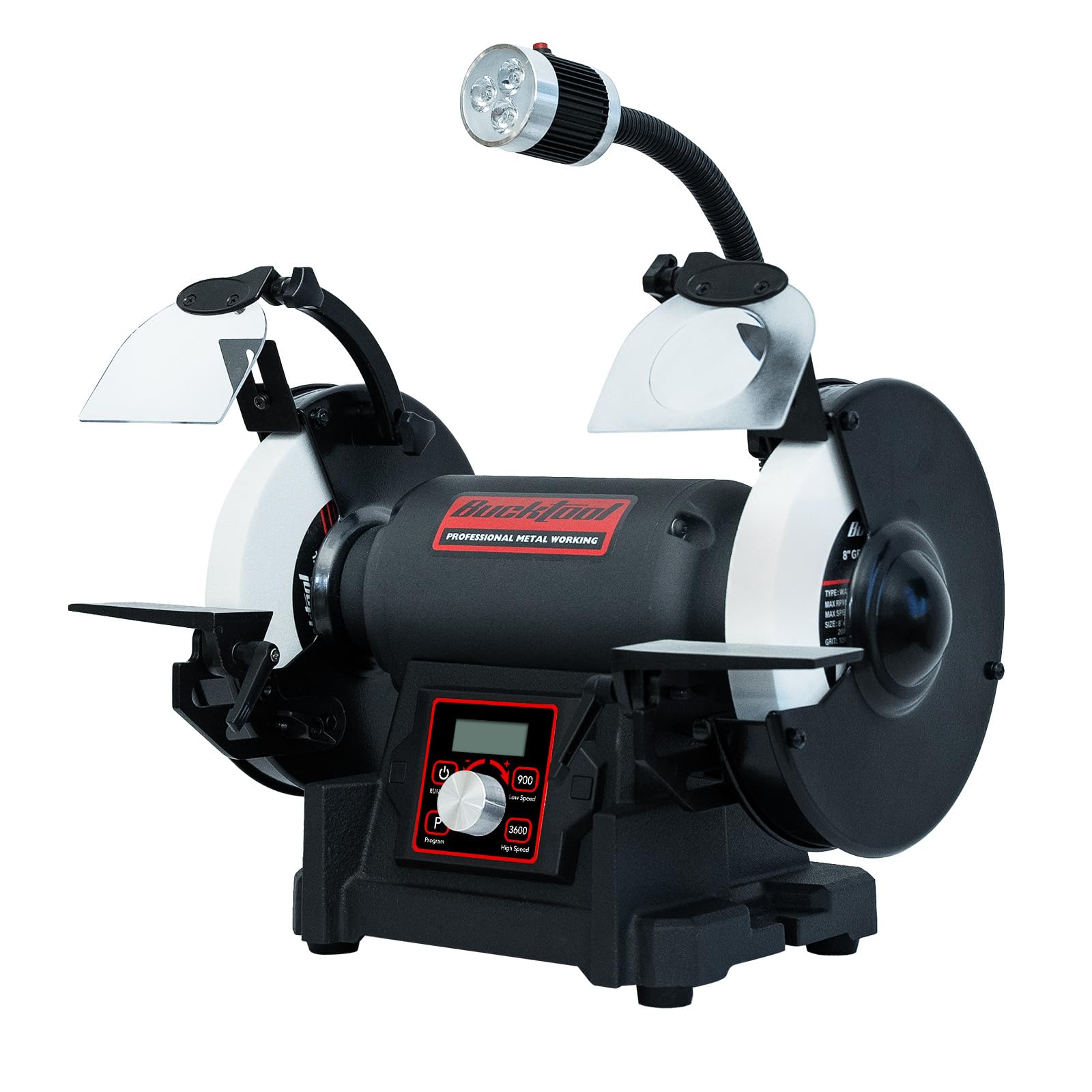
It can carry a large share of the work, but not the finishing step. The bucktool 8-inch Variable Speed Bench Grinder with Digital Display (TDS-G200VLGA) is a 3/4 HP, 5.0 A machine with variable speed shown on a digital display, which makes it suitable for shaping, bevel re-establishment and deburring at reduced speed. Final edge work on hardened steel, however, belongs on a water-cooled wet stone such as the bucktool 10-inch Wet Stone Sharpener (SCM8103), which runs at 90–160 RPM with water cooling. A second constraint is duty cycle: one verified buyer reported the machine becoming very hot after about five minutes of continuous use, so shorter passes with cooling intervals are the practical working method either way.
Third-party pricing analysis puts the 6-inch consumer segment — the dominant volume segment in the category — at typically USD 50 to USD 200, and larger or variable-speed machines sit above that band. The cost drivers behind the difference are wheel diameter (6-inch, 8-inch or 10-inch), motor rating (from 1/2 HP on the 6-inch models to 1.0 HP on the 8-inch high speed model), and whether the machine adds control hardware such as VFD or a digital speed display. A two-machine station costs more than a single grinder and takes more bench space; the trade-off is that heat-sensitive edge work and stock removal stop competing for the same wheel. Current pricing for the SCM8103 and TDS-G200VLGA is published on bucktool.com.
The verification sequence that matters is specification-level: confirm wheel diameter, speed range or control type, motor rating, input current and the safety certification mark for each machine, then check that the tool rest, eye shield and switch arrangement match your workshop safety policy. BUCKTOOL sells factory-direct through bucktool.com and states a 30-day return window, which gives a workshop a practical validation period after delivery. Buyers who want to confirm sample availability and current configurations before a workshop-level order can reach the team at service@bucktool.com.
For US buyers, BUCKTOOL states 3–5 day delivery, a 2-year warranty and 30-day returns. Two planning notes follow from that: consumables and accessories may come from different sources, so wheel compatibility and sharpening jig fit should be confirmed separately for the machine you choose; and because the sharpening jig systems used with these machines are third-party items, allow for their own lead time when scheduling a new sharpening station. After-sales contact is available by email at service@bucktool.com or by phone at 909-255-1088.
Conclusion: Two Machines, Three Jobs, One Repeatable Workflow
Knife sharpening, chisel honing and tool restoration pull a bench grinder in three directions, and the constraint that resolves the conflict is heat control, not horsepower. A station built around the bucktool 10-inch Wet Stone Sharpener (SCM8103) for slow water-cooled edge work, paired with the bucktool 8-inch Variable Speed Bench Grinder with Digital Display (TDS-G200VLGA) for controlled dry grinding, gives each job a machine that is suited to it rather than a compromise wheel that is not.
The setup checklist that follows from this guide is short: mount both machines on a rigid bench before wiring; confirm the CSA mark, the standard revision and the input current against your circuit; check terminals and wheel balance before the first cut; lock the tool rest and test it for movement; work in passes rather than continuous runs; and keep the wet stone for edges and the dry wheel for stock removal.

Next Step: Match the Machine to the Job
If your workshop sharpens knives and chisels and also restores used tools, the two-machine split is the configuration to specify. Confirm wheel size, speed control and certification first, then place the order.
Browse the bench grinder range at bucktool.com, or contact the team directly:
Email: service@bucktool.com | Tel: 909-255-1088 | WhatsApp: +86-15105354491
Have Questions or Need More Details?
Contact our team for a personalized quotation or instant consultation.
Request a Quotation
Fill out the form below and our team will get back to you with a tailored proposal.
WhatsApp Direct Chat
Prefer to chat in real-time? Message us on WhatsApp for instant assistance & quick answers.
- Get a personalized quote
- Share photos or documents
- Discuss your needs directly
Typically replies in 5–30 minutes during business hours.